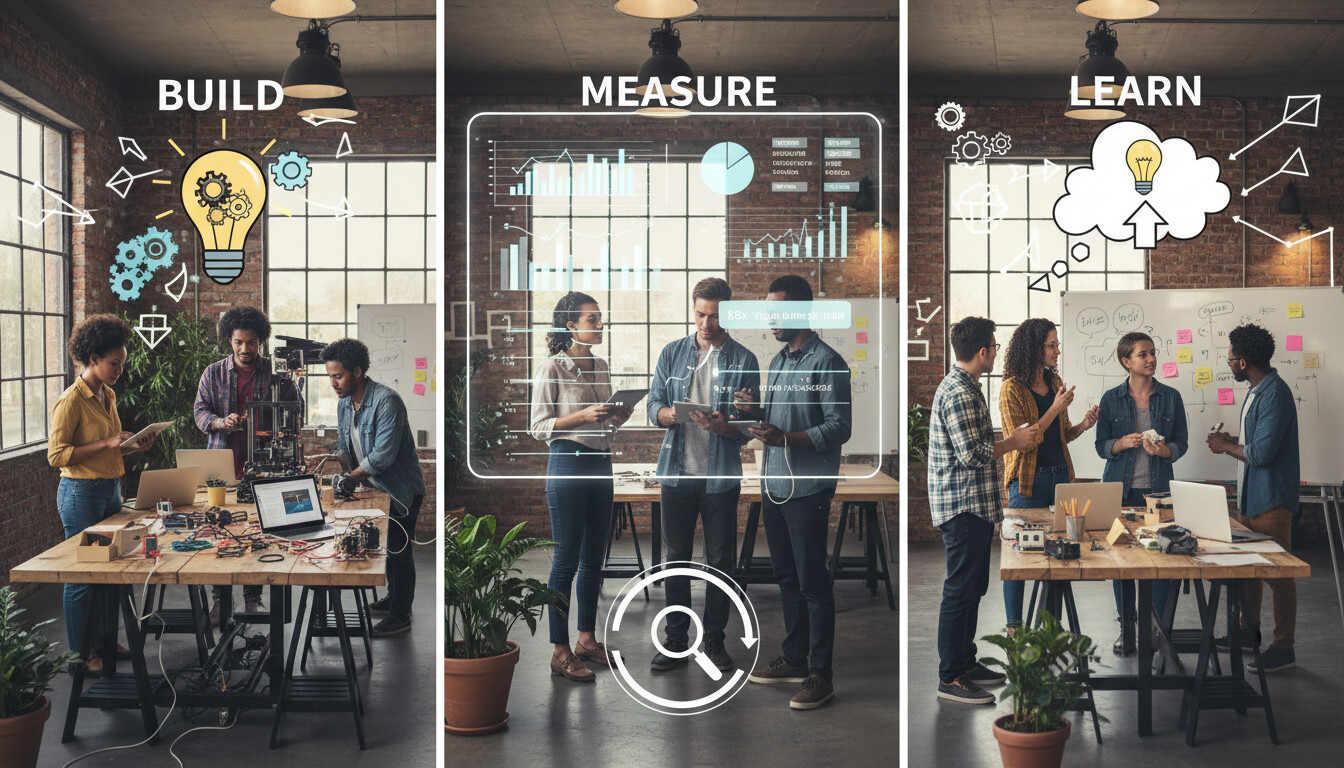
Every successful startup shares a common thread: they didn’t get it right the first time. Dropbox started with a simple video. Zappos tested demand by posting photos of shoes they didn’t own. Airbnb doubled their revenue by taking better photos. What connects these billion-dollar companies? They all mastered the Build-Measure-Learn framework—the engine that powers lean startup methodology and transforms uncertain ideas into validated products.
If you’re building an MVP in 2025, understanding this framework isn’t optional. It’s the difference between burning through your runway on assumptions and systematically discovering what your customers actually want. In this guide, we’ll break down exactly how to implement Build-Measure-Learn in your MVP development for startups journey—with practical steps you can apply today.
What Is the Build-Measure-Learn Framework?
The Build-Measure-Learn loop, introduced by Eric Ries in The Lean Startup, is a cyclical process designed to minimize waste while maximizing learning. Instead of spending months building a “perfect” product only to discover nobody wants it, you build the minimum viable version, measure how users respond, and learn from that data to inform your next iteration.
Here’s the critical insight most founders miss: the loop actually runs backwards in terms of planning. You start by identifying what you need to learn, then determine what you need to measure to learn it, and finally decide what to build to generate those measurements. This “learn-first” mindset prevents the common trap of building features nobody asked for.
The Three Phases Explained
Build: Create the smallest possible version of your product that allows you to test your core hypothesis. This could be a landing page, a clickable prototype, a concierge MVP where you manually deliver the service, or a basic functional product. The key is speed—not polish.
Measure: Implement systems to collect data on how users interact with what you’ve built. This means tracking specific, actionable metrics that tell you whether your hypothesis is correct. We’ll cover exactly which metrics matter later in this article.
Learn: Analyze the data to determine whether to persevere with your current strategy or pivot to a new approach. Validated learning happens here—you’re not guessing anymore; you’re making decisions based on evidence.
Why Build-Measure-Learn Matters More in 2025
The lean startup methodology has evolved significantly since 2011. In 2025, the integration of AI tools has supercharged each phase of the cycle. AI-assisted coding tools like GitHub Copilot can boost developer productivity by up to 55%, enabling faster building. AI-driven analytics can reduce validation time by 50% by analyzing customer behavior patterns more efficiently.
But technology alone doesn’t guarantee success. The fundamental principle remains: reduce uncertainty through rapid experimentation. Whether you’re bootstrapped or funded, the Build-Measure-Learn framework helps you make smart decisions about where to invest your limited resources.
What’s changed is the speed at which you can complete cycles. With low-code platforms, AI prototyping tools, and sophisticated analytics, startups can now run experiments in days rather than weeks. This means more iterations, faster learning, and higher chances of finding product-market fit before your competitors.
How to Implement Build-Measure-Learn: A Practical Guide
Theory is great, but let’s get tactical. Here’s how to actually implement this framework in your startup MVP development process.
Step 1: Start With Your Hypothesis
Before you build anything, write down your hypothesis. A good hypothesis follows this format: “We believe that [target customer] will [take specific action] because [reason].” For example: “We believe that busy professionals will pay $20/month for an AI-powered meal planning app because it saves them 3+ hours weekly on meal decisions.”
Notice how specific that is. It identifies the customer segment, the expected behavior, the price point, and the value proposition. That specificity matters—vague hypotheses lead to vague results.
Step 2: Build the Minimum Viable Test
Your first build should be embarrassingly simple. Dropbox didn’t build file syncing technology for their MVP; they made a video showing how it would work. Zappos didn’t buy inventory; they photographed shoes from local stores. The question isn’t “What’s the best product I can build?” but “What’s the fastest way to test my hypothesis?”
Options for your MVP build include:
- Landing page MVP: A simple page describing your product with an email signup or pre-order button
- Concierge MVP: Manually deliver the service to early customers before automating
- Wizard of Oz MVP: Users interact with what looks automated, but you’re doing the work behind the scenes
- Piecemeal MVP: Combine existing tools to deliver your value proposition
- Functional MVP: A basic working version with core features only
If you’re considering working with a startup MVP development partner, make sure they understand lean methodology. The best MVP software development companies will push back if you try to overload your first version with features.
Step 3: Define Your Metrics Before You Launch
Most startups fail here. They build, launch, and then scramble to figure out what to measure. You need to define your success metrics before you build.
Focus on actionable metrics—data points that tell you whether to continue, pivot, or stop. These include:
- Activation rate: What percentage of signups complete a key action?
- Retention rate: What percentage of users return after day 1, week 1, month 1?
- Conversion rate: What percentage of users convert from free to paid?
- Customer Acquisition Cost (CAC): How much does it cost to acquire each customer?
- Customer Lifetime Value (CLV): How much revenue does each customer generate over time?
Avoid vanity metrics that look impressive but don’t inform decisions. Total signups, page views, and social media followers can feel good but rarely tell you whether your product is actually solving a problem worth paying for.
Common Build-Measure-Learn Mistakes (And How to Avoid Them)
After working with dozens of startups, we’ve seen the same mistakes repeated. Here’s how to avoid them:
Mistake 1: Overbuilding the MVP
The number one mistake is building too much. Founders convince themselves that users “need” certain features before they’ll pay. In reality, users will tolerate rough edges if you’re solving a real problem. Your MVP should test your riskiest assumption with the minimum possible effort.
As we discussed in our article on why MVP development for startups differs from enterprise, startup MVPs need to optimize for learning speed, not feature completeness.
Mistake 2: Measuring Too Late
If you’re adding analytics after launch, you’ve already lost valuable data. Instrumentation should be part of your build phase, not an afterthought. Decide what you’re measuring before you write a single line of code.
Mistake 3: Ignoring Qualitative Feedback
Numbers tell you what’s happening. Customer conversations tell you why. The best learning comes from combining quantitative metrics with qualitative insights. Schedule regular customer interviews—aim for 5-10 conversations per learning cycle.
Mistake 4: Slow Learning Cycles
The power of Build-Measure-Learn comes from speed. If your cycles take months, you’ll run out of runway before you find product-market fit. Aim for weekly cycles when possible. If you can’t complete a cycle in a week, you’re probably building too much.
Mistake 5: Refusing to Pivot
Founders often become emotionally attached to their original vision. But the data doesn’t care about your feelings. When metrics consistently show your hypothesis is wrong, it’s time to pivot. Groupon started as a social activism platform called The Point before pivoting to daily deals—a change that led to a billion-dollar valuation.
Real-World Build-Measure-Learn Examples
Let’s look at how successful companies applied this framework:
Dropbox: The Video MVP
Drew Houston couldn’t easily demonstrate Dropbox’s file-syncing technology without building it first—a massive technical undertaking. Instead, he created a 3-minute video showing how it would work. The video went viral on Hacker News, and their beta waiting list jumped from 5,000 to 75,000 overnight. Hypothesis validated. Now it made sense to invest in building the actual product.
Zappos: The Concierge MVP
Nick Swinmurn wanted to test whether people would buy shoes online—a controversial idea in 1999. Rather than investing in inventory and warehousing, he photographed shoes at local stores and posted them online. When someone ordered, he bought the shoes at full retail price and shipped them. This inefficient model proved demand existed before he built the infrastructure.
Uber: The Minimum Viable Launch
Uber’s first version launched in San Francisco with just three cars. No surge pricing. No driver ratings. No route optimization. Just a basic app that connected riders with drivers. This minimal launch let them test core assumptions about demand before scaling to new cities.
Tools to Accelerate Your Build-Measure-Learn Cycle in 2025
Modern tools can dramatically speed up each phase of the cycle:
Building Faster
- No-code platforms: Bubble, Webflow, and Glide for rapid prototyping
- AI coding assistants: GitHub Copilot, Cursor, and Claude for faster development
- Component libraries: Shadcn/ui, Tailwind, and pre-built templates
Measuring Smarter
- Product analytics: Mixpanel, Amplitude, PostHog for user behavior tracking
- Session recording: Hotjar, FullStory for understanding user friction
- Feature flags: LaunchDarkly, Statsig for controlled experiments
Learning Faster
- Customer interviews: Calendly + Zoom for scheduling feedback sessions
- Survey tools: Typeform, Tally for gathering structured feedback
- AI analysis: Tools that analyze feedback patterns and summarize insights
If you need help selecting the right tools and approach for your specific situation, consider working with experienced professionals who understand how to hire an MVP developer or team that specializes in lean methodology.
When to Exit the Loop: Signs You’ve Found Product-Market Fit
The Build-Measure-Learn cycle isn’t infinite. At some point, you need to scale. But how do you know when you’re ready?
According to Andreessen Horowitz, product-market fit feels like “the market pulling product out of your startup.” Concrete signs include:
- Users keep coming back without prompting (high retention)
- Customers actively refer others (positive word of mouth)
- Usage grows faster than marketing spend (organic growth)
- Customers complain when the product is down (dependency)
- You can’t hire fast enough to keep up with demand
Until you see these signs, keep iterating. The Build-Measure-Learn framework is your compass—use it until you know exactly where you’re going.
Final Thoughts: Make Learning Your Competitive Advantage
The startups that win aren’t the ones with the best initial ideas. They’re the ones that learn fastest. The Build-Measure-Learn framework gives you a systematic way to turn uncertainty into knowledge, and knowledge into a product people actually want.
Start small. Measure everything that matters. Learn from both successes and failures. And remember: every iteration brings you closer to product-market fit—as long as you’re paying attention to what the data tells you.
The lean startup methodology has helped thousands of companies work through the uncertainty of building something new. In 2025, with AI-powered tools accelerating every phase of the cycle, there’s never been a better time to embrace this framework for your MVP development.
Frequently Asked Questions
How long should one Build-Measure-Learn cycle take?
Aim for weekly cycles when possible. If your cycles are taking months, you’re likely overbuilding. The goal is to learn quickly, not to ship perfect features. Some teams run multiple experiments simultaneously to accelerate learning.
What’s the difference between Build-Measure-Learn and Agile?
Agile is a development methodology focused on iterative delivery. Build-Measure-Learn is a business strategy focused on validated learning. They complement each other—many teams use Agile to implement their Build-Measure-Learn experiments.
When should I pivot vs. persevere?
Pivot when your data consistently shows your core hypothesis is wrong. Persevere when you see positive signals but need optimization. The key is defining success metrics upfront so you can make objective decisions rather than emotional ones.
Can I use Build-Measure-Learn without technical skills?
Absolutely. Many MVPs don’t require code at all—landing pages, concierge services, and Wizard of Oz tests can all validate hypotheses without technical development. No-code tools make this even easier in 2025.
Have questions about implementing Build-Measure-Learn in your startup? Drop a comment below—we read and respond to every one.